Technological Challenges for a Permanent Moon Base: NASA's Plans
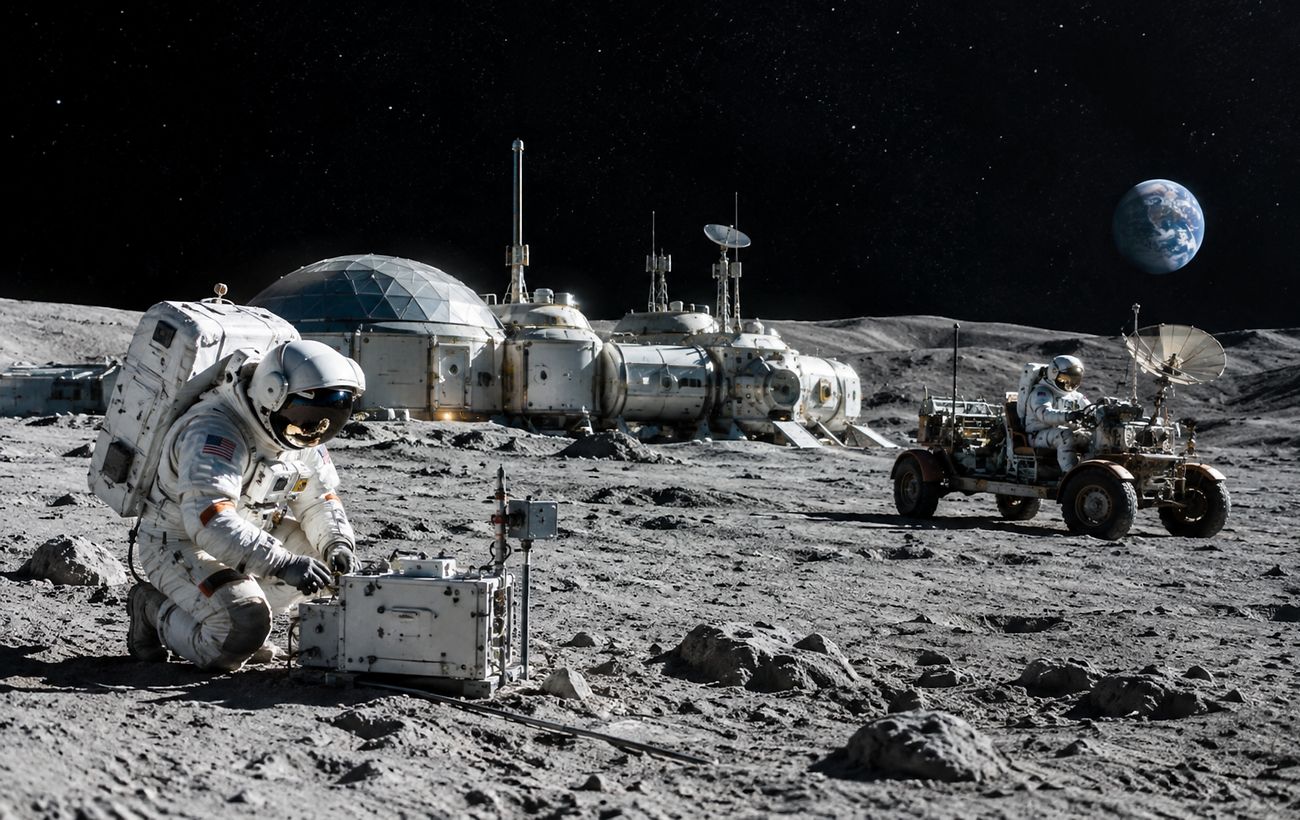
NASA is developing key engineering solutions for lunar sustainability, including power generation and radiation protection.
 💡Tech
Photo: RBC-Ukraine
Key points
- Use of nuclear reactors for stable energy
- Resource extraction directly on the Moon
- Equipment protection from abrasive lunar dust
- Using regolith for radiation shielding
Establishing a long-term human presence on the Moon requires overcoming a series of complex engineering barriers. NASA is actively working on technologies that will allow astronauts to autonomously provide for themselves without constant supplies from Earth.
Energy and Life Support
One of the primary challenges is stable power supply, as solar panels cannot operate effectively during the long lunar night. Consequently, the agency is exploring the implementation of compact nuclear reactors, specifically the Lunar Reactor-1, slated for launch in 2030.
In parallel, scientists are refining closed-loop systems for water and air regeneration, similar to those used on the ISS. Methods for In-Situ Resource Utilization (ISRU) are also being developed, including extracting oxygen from lunar regolith and utilizing water ice from the south pole.
Protection Against Harsh Environments
The lunar environment imposes strict requirements on equipment due to abrasive dust and cosmic radiation. To combat dust, electrodynamic shields are being tested, while layers of lunar soil are being considered as a natural shield for living modules to protect against radiation.
Source RBC-Ukraine — rbc.ua/ukr/news/vid-dernogo-reaktora-5g-shcho-potribno-nasa-1794836… ↗
Read next
 👥Society
Demographic forecast until 2030: how Ukraine's population will change
Demographer Oleksandr Gladun forecasts a decline in Ukraine's population to 26.2 million people if hostilities continue until 2030.
 🛡️Security
First drone attack on Kaliningrad region: incident details
For the first time since the beginning of the full-scale invasion, the Russian exclave of Kaliningrad region has been targeted by UAVs. The attack hit Baltiysk, where the…
 🛡️Security
Explosions reported in Russian Baltiysk near naval base
Drones targeted port infrastructure in the Kaliningrad region, where the Russian Baltic Fleet is based.
 🛡️Security
Mike Waltz: Russian military losses are becoming critical for sustaining the war
The US Permanent Representative to the UN stated that Russian monthly combat losses now significantly exceed their recruitment numbers.
 🎭Culture & Sport
US Forest Service declassifies archives on Bigfoot: what is known
The US agency has released documents regarding sightings of the legendary Bigfoot, accumulated over the past 80 years.
 🏙️City
Car color as a mirror of personality: what experts say about driver choices
Psychologists have analyzed how a vehicle's shade can reflect a driver's personality, explaining why practicality often outweighs aesthetics in vehicle selection.